


This conversation first aired as a Substack Live hosted by David Roy of ENG Sales Solutions. Thank you, David, for having me on.
Today’s episode is for you if:
A prospect says “That’s too expensive,” and your first instinct is to defend the price.
You don’t find out their budget until you present the Game Plan.
A “not right now” ends the conversation instead of starting your follow-up.
“That’s too expensive.”
When you hear that, the instinct is to defend.
You list the features. You justify the number. You push back.
That’s overcoming an objection. And it puts you on one side of the table and your buyer on the other.
There’s a better first move: Slow down and label it.
“When you say too expensive, it sounds like you have a specific number in mind that you’re comparing that to. Would you be open to sharing what that number is?”
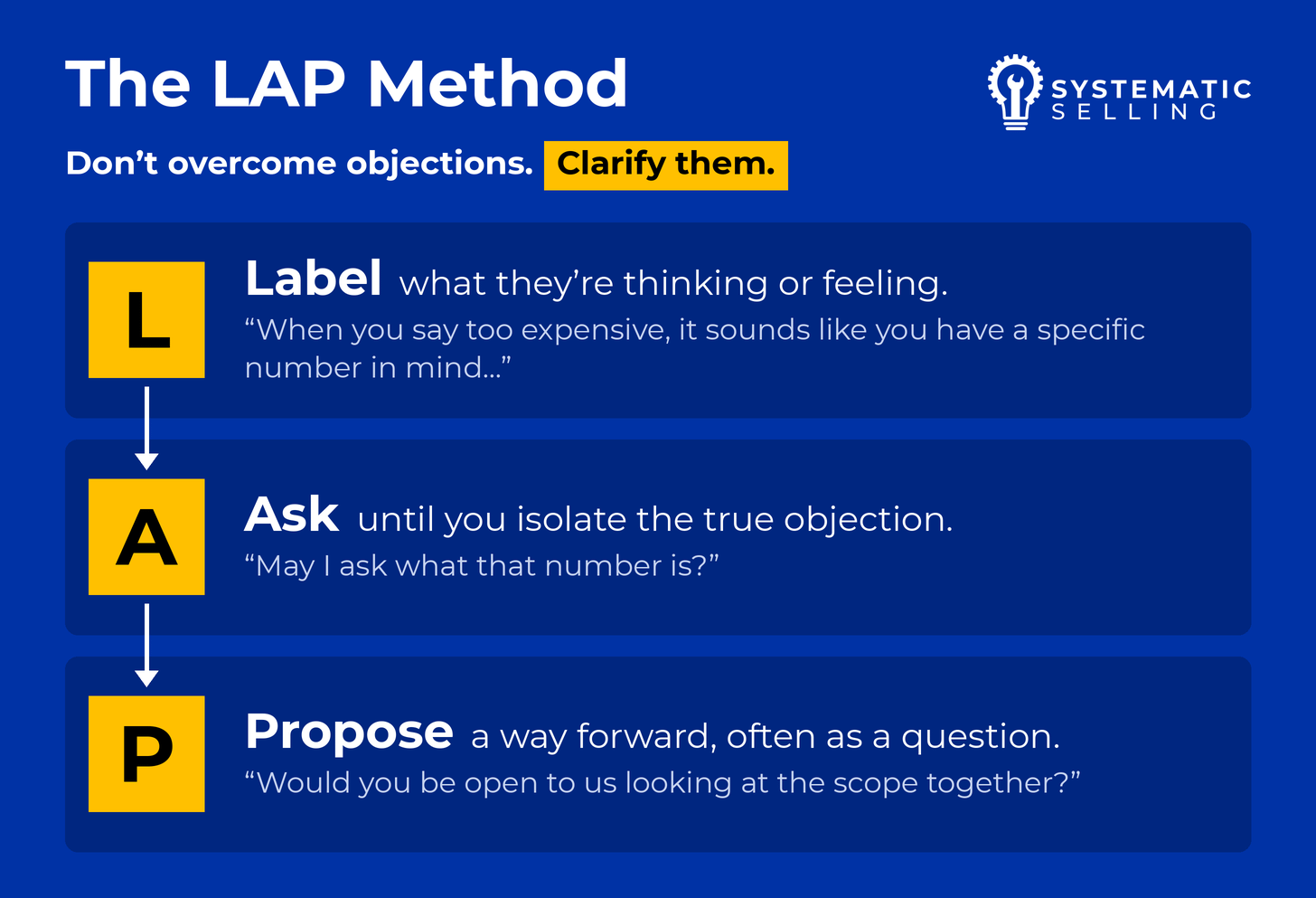
That one line takes you out of defensive mode and into a conversation. It’s the first step of what we call the LAP Method: Label, Ask, Propose.
The lesson applies to any trade, service or B2B business:
When a prospect pushes back, price often isn’t the real problem. The real question is whether you have a problem worth solving together… or simple misalignment. Clarifying tells you which.
“Too expensive” often isn’t about price. It’s about trust or fit, and the LAP Method tells you which.
And when your sales process runs well, most objections never make it to the Game Plan at all.
David Roy and I spent our latest Substack Live on clarifying objections instead of overcoming them, with real stories from David’s commercial sales work.
Here are the key takeaways from our conversation, with timestamps so you can jump to what matters most for you and your team.
1. Clarify objections. Don’t overcome them.
Overcoming an objection puts you on one side of the table and the customer on the other. Clarifying is collaborative. You work together to answer one question:
“Is this a problem we can truly help solve, or is there simply misalignment?”
2. Use the LAP Method: Label, Ask, Propose.
Label what they’re thinking or feeling. Ask until you isolate the true objection. Propose a way forward, often as a question.
When a customer says “That’s too expensive,” start with the Label:
“When you say too expensive, it sounds like you have a specific number in mind...”
The Ask:
“May I ask what that number is?”
Once they’ve shared where they’re coming from, the next step is to Propose:
“Would you be open to us looking at the scope together to ensure that we are talking about the same thing?”
3. Pre-sell the budget before price becomes an objection.
Don’t ask, “What’s your budget for this project?”
Because often you’ll get, “Gee. I don’t know. What’s the price?”
Instead, provide a range—a Budget Pre-Sell—to get a sense of where the prospect stands:
“Typically, with jobs like this, you’re looking at about $3,000 to $4,000. Does that fit in line with what you were looking to invest in this project?”
Now, you can have a conversation to uncover whether there’s enough alignment to take the next step.
4. When it’s misalignment, stop selling.
Not every objection should be overcome. If there’s true misalignment, stop: save them the time and save yourself the time.
In commercial sales, when you’ve built high trust, a true objection is often an ask for help:
“We would love to work with you. But I can’t go to the owner with this number because we’ve got a bid that’s $2,500 less. Can you walk me through this and help me justify this?”
5. Stay in sight with a quarterly check-in.
As David put it, a lot of times “no just means not now.” Many of my commercial clients send a short email about two weeks before each quarter. Nothing salesy:
“For our planning, do you anticipate needing any budgets, quotes or any other support from us over the next quarter?”
Out of sight, out of mind. In sight, on mind, on target toward your goals.
The Bottom Line
When a prospect says “too expensive,” you don’t need a better rebuttal. You need a better question.
So before you defend your price, slow down. Label what you heard. Ask until you find the real objection. Then propose a way forward.
Sometimes it’s a gap you can close together. Sometimes it’s misalignment… and the best move is to stop selling.
Either way, you win back your time. And the more time you invest with prospects who align, the more you’ll close… faster, at a higher margin and without forcing anything.
Sean M. Lyden is the founder and CEO of Systematic Selling, a sales systems training company for growth-minded founders and their sales teams looking to scale their sales (without the chaos).
Want the next one in your inbox?
Subscribe free for practical, no-pressure sales systems training built for founders and their sales teams.
Already a subscriber? PRO members unlock the full archive of subscriber-only playbooks, including the Selling on LinkedIn (Without Being Salesy) series. It’s $8/month or $80/year. If it fits where your team is headed, upgrade anytime.
P.S. Hit reply and tell me the objection you hear most. I read the replies, and they shape what I write next.


