

Today’s email is for you if:
You know your team is leaving money on the table…but you’re not sure how to fix it without turning them into pushy salespeople.
You’ve told your team to “mention other services,” but it’s not happening consistently…or it’s happening badly.
You suspect the real issue isn’t skill. It’s that your team feels uncomfortable with the whole idea of upselling.
New to Systematic Selling?
Subscribe Free
Join hundreds of growth-minded founders and their sales teams who get bite-sized sales systems training delivered to their inbox every week — and start applying proven strategies in your next sales conversation.
Go PRO
Want the full playbook? PRO members get access to the entire archive, plus exclusive training you won't find anywhere else. All for less than a Venti Latte per month ☕️.

The What
Imagine…You’re already in the customer’s home or business. They already trust you enough to let you in the door. And yet, most service companies leave too much money on the table every week because their teams don’t know how to bring up additional services.
Or they’re afraid to try.
Today, I’m going to show you the CASH Method—a simple, four-step framework for asking for the upsell in a way that feels helpful, not pushy. It gives your team the exact words and structure to expand the conversation from the service the customer asked for to the other services you offer…without making the customer feel like they’re being “sold.”
The Why
Before we get to the framework, let’s address the elephant in the room.
Why does upselling feel so uncomfortable?
Because most of us are carrying around a toxic frame about what upselling is. We tell ourselves that upselling is being greedy. Being pushy. Being annoying. And when that’s the story running through your head, of course you’re not going to bring up additional services. You don’t want to be that person.
But here’s the reframe:
❌ Upselling is greedy.
✅ Upselling is being of service.
Your customer has a problem they may not even realize exists yet. If you see it and say nothing, you’re not being polite…you’re withholding help.
❌ Upselling is being pushy.
✅ Upselling is protecting the customer’s interests.
You’re the expert. They’re trusting you to look out for them. When you spot something they need and mention it, you’re doing exactly what they hired you to do.
❌ Upselling is being annoying.
✅ Upselling is respecting the customer’s ‘right of refusal.’
If you do it right, upselling doesn’t force anything on anyone. You’re giving the customer the information and the choice. They get to decide. And as you’ll see with the CASH Method, the framework is specifically designed to make saying “no” perfectly comfortable.
Which, counterintuitively, makes getting “yes” much more likely.
Once you make this mental shift, upselling stops feeling stressful and starts feeling like a natural part of the job.
Two Pictures
Now let me paint two pictures so you can see what’s at stake.
Picture #1: You don’t have a system for upselling.
You run a home maintenance company. A customer books you for gutter cleaning. Your tech shows up, cleans the gutters, and heads to the next appointment. Great work. Happy customer.
But that customer has no idea you also offer dryer vent cleaning, pressure washing, window washing, and a dozen other services — all of which could have been bundled into a single visit. So next month, they’re Googling “dryer vent cleaning near me” and hiring someone else. Not because they didn’t like you. They just didn’t know.
Meanwhile, you’re spending more money on marketing to attract new customers, when the easiest revenue was already standing right in front of your team.
Picture #2: Your team is trained on the CASH Method.
Your tech arrives at the job, casually mentions the other services you offer, and asks a simple, low-pressure question. The customer says, “Actually, yeah—I’ve been meaning to get that taken care of.”
Boom. The average ticket goes up. The customer gets more value. And your team doesn’t feel uncomfortable with asking for the upsell.
Here’s the reality: your customers want to know what else you offer. They’d rather hire someone they already trust than start from scratch with a new provider.
When you don’t mention your other services, you’re not being “polite.” You’re doing the customer a disservice.
But you can’t just tell your team, “Hey, start upselling.” That’s how you get awkward pitches that damage trust.
You need a framework. A script. A system.
That’s where the CASH Method comes in.
The How
The CASH Method is a four-step sequence designed to make the upsell feel like a natural extension of the service you’re already providing…not an awkward sales pitch bolted on at the end.
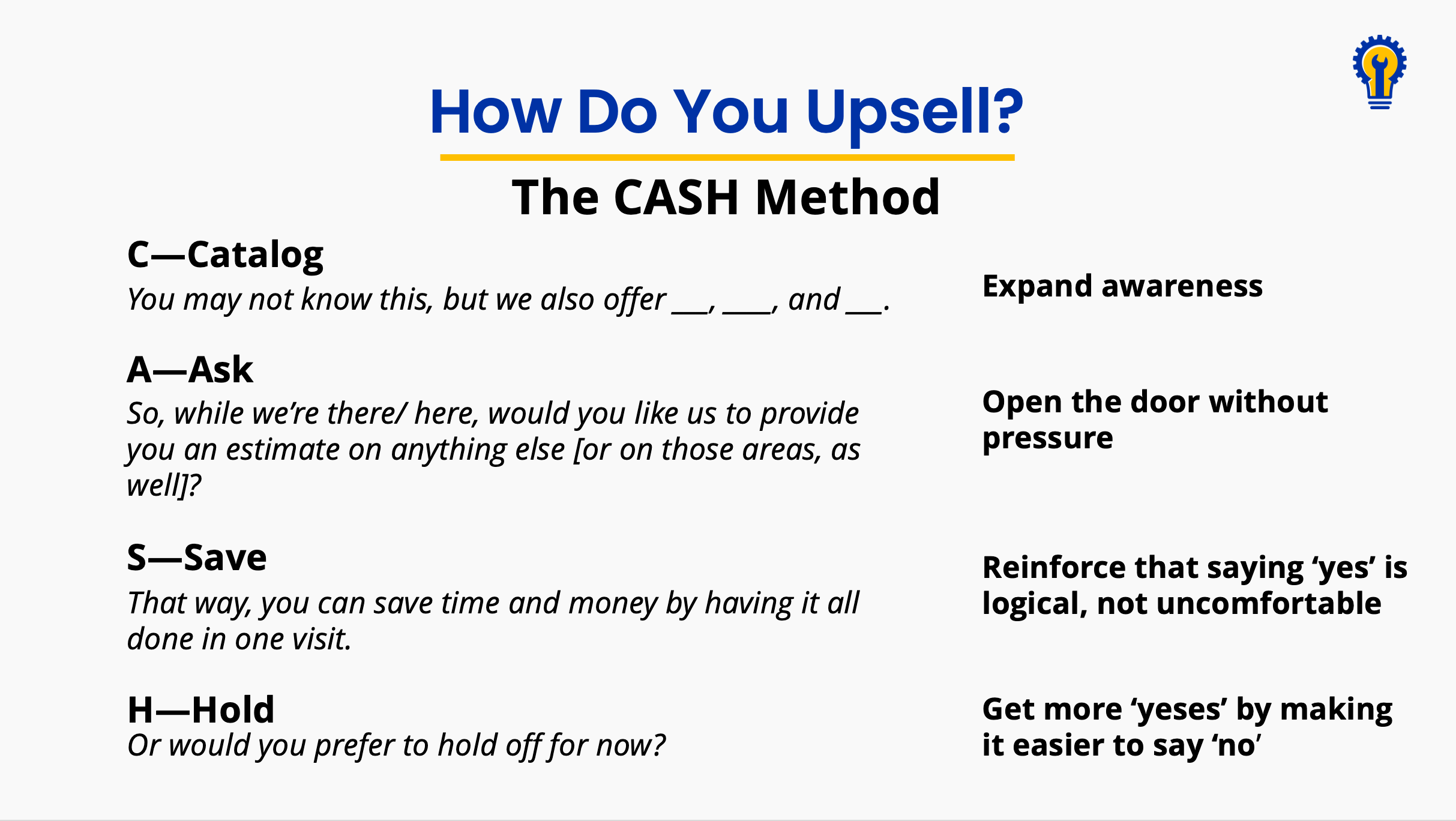
Here’s how each step works:
C — Catalog
Purpose: Expand awareness.
Most customers only know you for the one service they called you about. The “Catalog” step is where you plant the seed by letting them know what else you offer.
The script:
“You may not know this, but we also offer [Service A], [Service B], and [Service C].”
That’s it. No pressure. No pitch. Just information.
Why does this matter? Because you can’t sell what people don’t know you offer. This step builds the bridge from “I hired you for one thing” to “Oh, you do that too?”
A — Ask
Purpose: Open the door without pressure.
Now that the customer knows what else you offer, invite them to explore it—with a question, not a push.
The script:
“So, while we’re here, would you like us to provide you an estimate on anything else—or on those areas as well?”
Notice the phrasing. You’re not saying, “You should also get your [X] done.” You’re asking if they’d like an estimate. It’s an invitation, not a directive.
And the phrase “while we’re here” is doing the heavy lifting—it signals convenience, not an additional sales call.
S — Save
Purpose: Reinforce that saying “yes” is logical, not unreasonable.
Here’s where you give the customer a rational reason to say yes—one grounded in their self-interest.
The script:
“That way, you can save time and money by having it all done in one visit.”
This step reframes the upsell from “you’re spending more” to “you’re being smart about it.” It removes the friction by appealing to efficiency, something every homeowner and business owner values.
You’re showing them how to save, not asking them to spend more.
H — Hold
Purpose: Get more “yeses” by making it easier to say “no.”
This is the most counterintuitive step in the framework.
The script:
“Or would you prefer to hold off for now?”
Wait—why would you give them an easy out?
Because when people feel pressured, they resist. But when they feel like they have a genuine choice—when saying “no” is perfectly okay—they’re more likely to say “yes.”
The “Hold” step removes the tension. It tells the customer, “I’m not here to pressure you. I’m here to help.” And paradoxically, that’s exactly what gets them to lean in.
Remember the reframe: upselling is respecting their “right of refusal.” The “Hold” step is where you put that value into practice.
Putting It All Together
Here’s what the full CASH Method sounds like in practice.
Your tech arrives on site to clean the gutters and says:
"You may not know this, but we also offer dryer vent cleaning, pressure washing, and window cleaning.
So, while we're here, would you like us to take a look at any of those aspects of your home and provide you an estimate? That way, you can save time and money by having it all done in one visit. Or would you prefer to hold off for now?"
Notice how it flows. It’s conversational. It’s helpful. And it takes less than 30 seconds to deliver.
The customer doesn’t feel ambushed. They feel informed. And that’s the difference between upselling that builds trust and upselling that breaks it.
The What Now
Here’s your assignment to put the CASH Method into action this week:
Step 1: Check your mindset.
Before you train your team on the framework, take an honest look at your own beliefs about upselling. Are you carrying the old frame—greedy, pushy, annoying?
Write down the reframe and put it somewhere your team can see it: Upselling is being of service. Upselling is protecting their interests. Upselling is respecting their right of refusal.
If you don’t believe it, your team won’t either.
Step 2: Build your Catalog.
Sit down and list every service your company offers. Then, for each service, identify the 2–3 other services that are the most natural cross-sell or upsell.
For example, if you’re an HVAC company, a routine maintenance call is a natural opening to mention duct cleaning or air quality testing. Write these pairings down so your team knows exactly what to mention and when.
Step 3: Write your CASH scripts.
Using the framework above, write out the full CASH sequence for your top 2–3 service pairings. Make them sound natural.
Step 4: Role-play it.
Before your next team meeting, pair up your reps and/or your lead technicians and have them practice the CASH script on each other. One person plays the rep/ tech; the other plays the customer.
Run through it a few times until it feels natural, not robotic.
The goal isn’t perfection. It’s getting in the repetitions. The more you and your team practice and use the CASH Method, the more natural it becomes…and the more revenue you’ll generate from customers who are already standing right in front of you.
Sean M. Lyden is the founder and CEO of Systematic Selling, a sales systems training company for growth-minded founders and their sales teams looking to scale their sales (without the chaos).