

Today’s email is for you if:
You’re tired of constantly chasing new leads because the old ones keep “falling off” your radar.
Your pipeline feels like a revolving door…people come in, people disappear, and you’re always starting over.
You're great at meeting people but struggling to convert them.
New to Systematic Selling?
Subscribe Free
Join hundreds of growth-minded founders and their sales teams who get bite-sized, systematic sales training delivered to their inbox every week — and start applying proven strategies in your next sales conversation.
Go PRO
Want the full playbook? PRO members get access to the entire archive, plus exclusive training you won’t find anywhere else. All for less than a Venti Latte per month ☕️.


The What
Imagine...You meet someone at a chamber event. Great conversation. You exchange cards. You send a follow-up email. And then...nothing happens. They don’t respond. They don’t buy. So you move on.
A month later, you see them at another event. They’re friendly. They remember you. They fit your ICP (ideal customer profile), but they’re still not ready to buy.
So you mentally label them a dead lead.
Six months later, you find out they hired your competitor—for a service you offer—because, when they were finally ready, you weren’t on their radar anymore.
Sound familiar?
Here’s the problem. It’s not that you didn’t follow up. It’s not that you pushed them away. It’s the mental model you’re using to manage your relationships.
Most of us were taught to think about sales as a funnel. Wide at the top. Narrow at the bottom. Pour people in, filter them down, and hope enough come out the other end as customers.
Today, I’m going to show you a different model: The Sales Orbit—a framework for managing every relationship in your sales process so that no one falls through the cracks, trust compounds over time, and the right people move toward you naturally.
The Why
Before we get to the framework, let’s talk about why the orbit works better than the funnel.
Three reasons.
1. It takes the pressure off.
The funnel creates pressure on both sides of the conversation.
If your mental model says prospects must move through a linear sequence and convert at the bottom or get eliminated, then every interaction carries the weight of “Is this person going to buy or not?” You push. They resist. The whole dynamic turns adversarial.
The orbit flips that.
For example, when you meet new people at networking events, your only job is to get them into your orbit. That’s it. You’re not trying to close anyone. You’re trying to connect.
Then, as you cultivate that relationship over time, you create a “gravitational pull” of trust that draws the right people to you…ready to do business with you.
Here’s how I think about it. I teach a concept called the Trust Continuum—a scale from zero to ten. Zero means “I don’t know you and I don’t trust you.” Ten means “I’ll buy whatever you’re selling and tell everyone I know to do the same.”
When you’re networking, all you’re doing is moving someone from a zero to a one. “I didn’t know you. Now I do.”
That’s the entire objective.
And when you give yourself permission to focus only on that zero-to-one move, you show up differently. More relaxed. More curious. More likable. And paradoxically, more effective.
2. No lead gets left behind.
In a funnel, if someone doesn’t convert, they fall out. Gone. All the time and energy you invested? Wasted.
But people don’t stop being potential customers just because they didn’t buy today.
Maybe they weren’t ready. Maybe the timing was off. Maybe the budget wasn’t there yet. In a funnel, those people disappear. In an orbit, they stay in motion, circling at whatever distance reflects their current level of trust and readiness.
You keep nurturing them. Not with aggressive follow-up. Not with “just checking in” emails that go nowhere. With small, genuine touches…a thoughtful LinkedIn comment, a useful article, a quick note when you see something relevant to their business. Each one nudges them a little further to the right on the Trust Continuum.
So when their timing does align—when the budget frees up, when the old vendor drops the ball—you’re the first person they think of.
3. It unlocks the compound effect of trust.
Trust compounds. The more interactions you have with someone, the more they trust you. The more they trust you, the more they open up. The more they open up, the more likely they are to buy—and to refer.
But compounding requires time.
You won’t see the payoff after one networking event. Probably not after five. But somewhere around the three-to-six-month mark of consistently showing up, following up, and building relationships, something shifts. You hit a tipping point. The phone rings. Referrals come in. People you met months ago reach out because they finally have a need. And you’re the one they trust.
The funnel doesn't give you that runway. It's impatient by design…convert now or let them go. The orbit is patient by design. Keep people in motion. Keep building trust. Let the compounding work.
And once you hit that tipping point, growth accelerates because every person who reaches your Center of Gravity starts pulling new people into your outer orbit through referrals and introductions
The How
The Sales Orbit is built on one core principle: trust is the gravitational pull.
Think of it like actual gravity. Every person you meet enters your orbit. And trust—not pressure—is the force that pulls them closer. The stronger your gravitational pull, the closer they get. The weaker it is, the more they drift away.
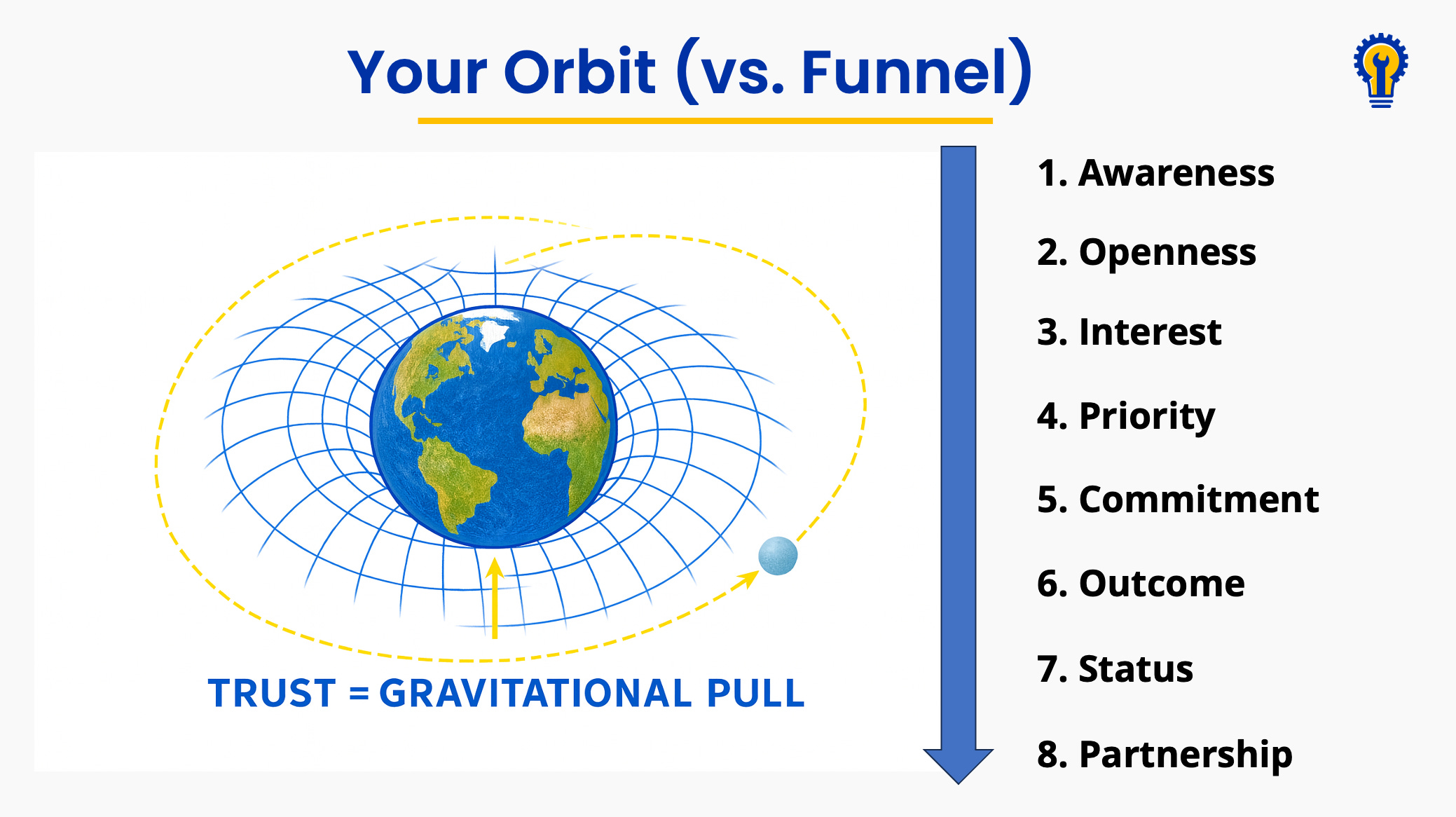
The 8 Stages of the Sales Orbit
Here’s how the buyer’s journey maps to the orbit model. Each stage represents a deeper level of trust:
1. Awareness — “I know you exist.” You’ve met at an event. You’ve connected on LinkedIn. You’ve gone from a zero to a one on the Trust Continuum. That’s it. And that’s enough…for now.
2. Openness — “I’m open to you.” They’re not looking to buy. But the wall isn’t up. They’ll read your content. They’ll take your call. They’re receptive.
3. Interest — “This is relevant to me.” Something clicked. They have a specific need, and what you do might address it. They’re paying attention now.
4. Priority — “This might matter now.” Their need has become urgent enough that they’re actively weighing options. You’re one of them.
5. Commitment — “I trust you enough to buy.” They’ve decided to move forward. Not because you pressured them. Because the trust you built gave them the confidence to say yes.
6. Outcome — “You delivered.” You did what you said you’d do. Most people think customer experience starts here. But if you’ve been following the orbit model, you’ve been delivering an exceptional experience since Stage 1.
7. Status — “I look good because of you.” Your work made them look smart for choosing you. When someone’s reputation benefits from hiring you, they become fiercely loyal.
8. Partnership — “I refer you. I advocate for you.” They’re no longer just a customer. They’re a partner. They send referrals. They introduce you to their network. They become, essentially, an unpaid member of your sales team.
The 3 Phases: Where the Orbit Becomes Actionable
Those eight stages cluster into three phases. This is where the framework becomes something you can actually use because each phase tells you exactly what your job is and what activities to focus on.
Phase 1: Outer Orbit — Entry and Exposure (Stages 1–2)
Your job: Get on their radar. Go from stranger to known entity.
This is where networking lives. You’re not selling here. You’re planting seeds. You’re showing up at events, posting on LinkedIn, making introductions, and doing low-pressure outreach. Every handshake, every connection request, every “great to meet you” email moves someone from a zero to a one on the Trust Continuum.
The simple definition: You’re on their radar.
The activities: Networking events. LinkedIn content. Introductions. Cold outreach.
Phase 2: Inner Orbit — Engagement and Consideration (Stages 3–4)
Your job: Deepen the relationship. Diagnose problems. Create alignment.
This is where one-to-one conversations happen. You’re asking questions driven by genuine curiosity. You’re learning about their business, their challenges, the gap to their goals. You’re following up across channels…email, LinkedIn, coffee meetings. Trust is compounding with every interaction.
The simple definition: You’re someone they’re considering.
The activities: One-to-one meetings. Discovery conversations. Value-added touches. Multi-channel follow-up.
Phase 3: Center of Gravity — Conversion and Expansion (Stages 5–8)
Your job: Close cleanly. Deliver results. Turn clients into partners.
This is where the prospect stops orbiting and arrives. They've reached the center—the point of highest trust. Here's what makes this fundamentally different from the bottom of a funnel: it doesn't end with the sale. It expands through outcome, status, and partnership. You deliver. You make the customer look great for choosing you. And then they pull new people into your outer orbit through their referrals and introductions.
The simple definition: You’re their trusted provider.
The activities: Scope review calls. Clear closes. Exceptional delivery. Referral activation. Partnerships.
Why This Isn’t Just a Rebranded Funnel
You might be thinking, “Sean, this sounds like Top of Funnel, Middle of Funnel, Bottom of Funnel with different labels.”
It’s not. And the difference matters.
A funnel narrows. It’s designed to eliminate. The whole metaphor is about pouring a large volume in and getting a small trickle out. And anyone who doesn’t convert? Gone.
An orbit expands. Every person who enters stays in motion—moving at their own pace, getting closer as trust builds. And when someone reaches your Center of Gravity and becomes a partner? They pull new people into your outer orbit through referrals. Which means your orbit grows as you serve it.
The funnel is a one-way street. The orbit is a flywheel.
The Now What
Here are three things you can do this week to start operating with an orbit mindset:
Step 1: Reframe how you think about “dead” leads.
Pull up the prospects you wrote off because they didn’t buy. They’re not dead; they’re in your outer orbit. Pick three of them this week and re-engage. Send a value-added touch. Comment on one of their LinkedIn posts. Reconnect without an agenda. Bring them back into motion.
Step 2: Map your top 10 relationships to the 8 stages.
Open a spreadsheet or grab a sheet of paper. Write down the names of your 10 most important prospects or relationships right now. Next to each name, identify which of the 8 stages they’re currently in. Be honest—most of them are probably earlier in the orbit than you think.
Step 3: Identify your “one next nudge” for each.
For each of those 10 relationships, write down the one thing you could do this week to move them one stage closer to a sale…and becoming a partner. That might be a follow-up email, a LinkedIn comment, a coffee invitation, or simply showing up at an event where you know they’ll be.
The Bottom Line
The funnel asks: “How do I get this person to buy?”
The orbit asks: “How do I earn this person’s trust?”
One question creates pressure. The other creates pull.
Build the orbit. The sales will follow.
Sean M. Lyden is the founder and CEO of Systematic Selling, a sales systems training company for growth-minded founders and their sales teams looking to scale their sales (without the chaos).
The shift from ‘how do I get this person to buy’ to ‘how do I earn this person’s trust’ is the right reframe.
I’d add that the compounding you describe doesn’t stop at the first sale. In my experience, the same orbit logic applies inside your customer base.
The founders I see struggling most aren’t losing new deals, they’re losing the compounding that should happen after the deal closes. They treat the sale as the finish line when it’s actually the starting point of the same trust-building motion.
The customers who’ve been nurtured longest are the ones who refer, expand, and re-engage.
The orbit gets them in. What keeps it spinning after that?